What if strength isn’t found in having answers, but in the courage to ask better questions?
What if growth isn’t a matter of fixing yourself or adding something new, but of noticing the contradictions we carry beneath habit, pride, and fear?
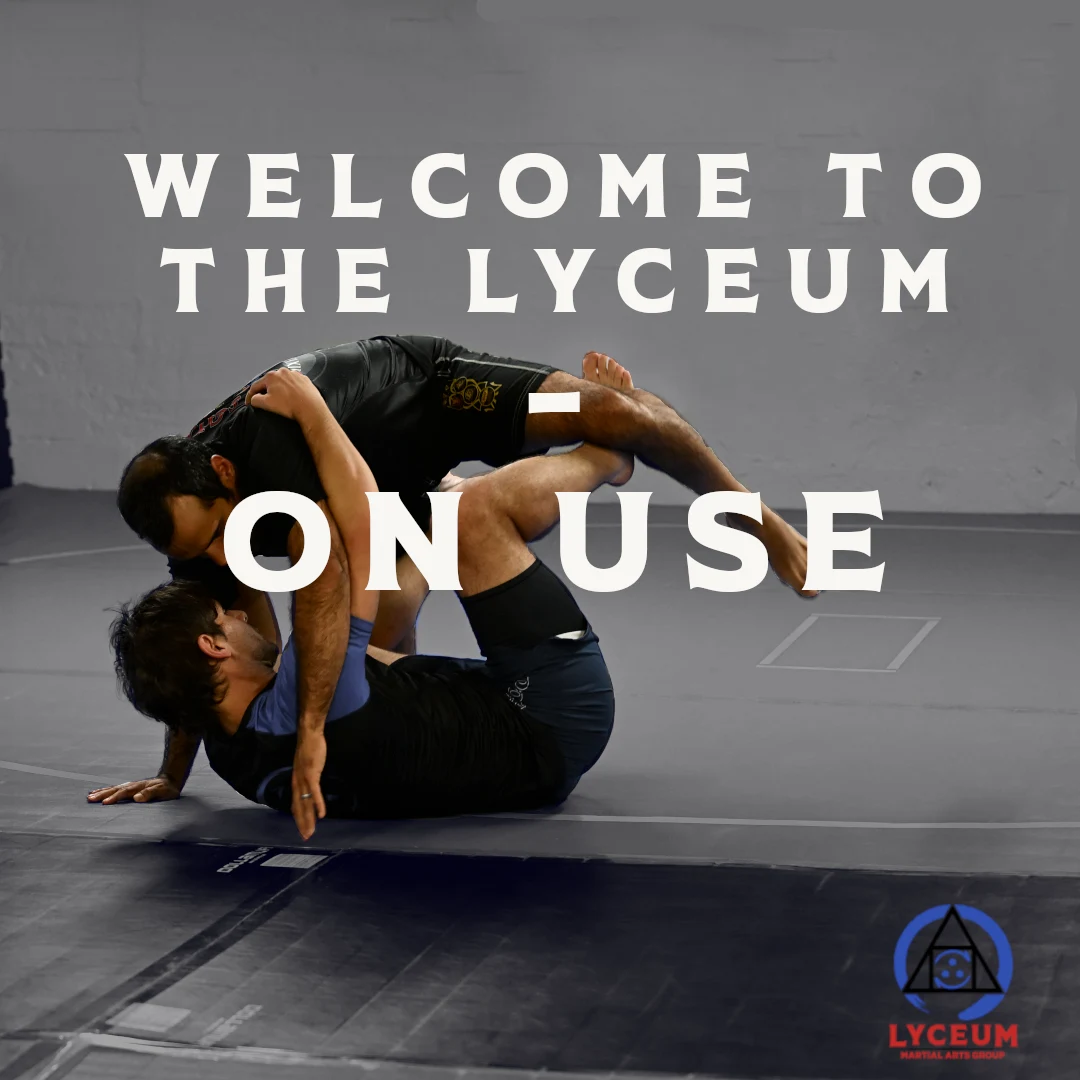
These questions sit at the center of The Lyceum Martial Arts Group, a place where thinking and training meet, where inquiry is shaped through movement, and where the body becomes a partner in understanding. It’s been said, “To be is to be perceived.” Training makes this unavoidable.
The Lyceum exists for the curious. For anyone who senses that growth hides inside friction: the honest kind found in effort, failure, repetition, and humility. This is a space to train together physically, mentally, and philosophically. We treat movement as conversation, martial arts as inquiry, and the body as the place ideas are embodied and integrated.
If you move with curiosity, if you question with humility, if you find meaning in both stillness and strain, then you’re already on this path. The Lyceum isn’t just a place to read or train. It’s a place to explore what happens when inquiry becomes embodied, when learning becomes something you do with breath, balance, pressure, and attention.
My background crosses martial arts, climbing, coaching, music, and philosophy. Not as separate pursuits, but as different languages in the same ongoing conversation. I’m not writing from a place of mastery. I’m writing from a place of practice, forming questions, developing experiments, testing ideas, and learning from the mistakes that keep shaping the work. Some of them persistent and recurring. No one here claims final answers. What we share is a commitment to learning and a willingness to stay in the process.
I may be the primary writer and organizer of this Substack, but The Lyceum is not led by one person. It is facilitated by others, working together to guide the training and the conversations it creates.
This isn’t a manifesto or a marketing pitch, something I’ve always thought promises too much or freezes us in time. It’s an open mat for thought, another place to explore what The Lyceum Martial Arts Group is trying to become; a space to think with your whole self.
The writings collected here are meant to function less like articles and more like working notes. They are not instructions to follow blindly, nor essays meant to be agreed with. Think of them as a kind of shared manual - part student guide, part session leader manual, part open conversation about what we are trying to practice and why.
For trainees and learners, these pieces offer context: language for experiences you may already feel in training but haven’t named yet. They are meant to help you notice patterns, question habits, and understand how physical practice connects to attention, effort, fear, and choice.
For session leaders, they serve as a mirror and a prompt. A way to examine how ideas show up under pressure, how intention survives contact with reality, and how teaching remains a form of learning when taken seriously.
For everyone, they are an invitation to think in motion. Nothing here is finished. Ideas are tested on the mat, revised through repetition, and sometimes abandoned when they no longer hold up. Agreement is not required. Engagement is.
If these writings do their job, they won’t give you answers to carry. They’ll give you better questions to train with.
Here, you’ll find writing on willpower and fear, not the dramatic kind, but the quiet versions that steer identity. Reflections on self-concept, contradiction, and discipline as devotion. Notes on cohesion and the ongoing attempt to align what we think, say, and do, and of course, martial arts. Sometimes topics are analytic, sometimes Eastern-inspired, sometimes nothing more than the conversation between breath and movement, but every idea begins in the body, because that’s where truth tends to reveal itself first.
We don’t train to become perfect. We train to become aware. We test our limits not to conquer them, but to understand their shape. Cohesion isn’t something we finally find; it’s something we practice.
There is dignity in not knowing. There is power in skepticism. And there is something sacred in pursuing understanding, so long as we are willing to leave that pursuit unfinished.
Train, read, reflect. And question everything, especially this.