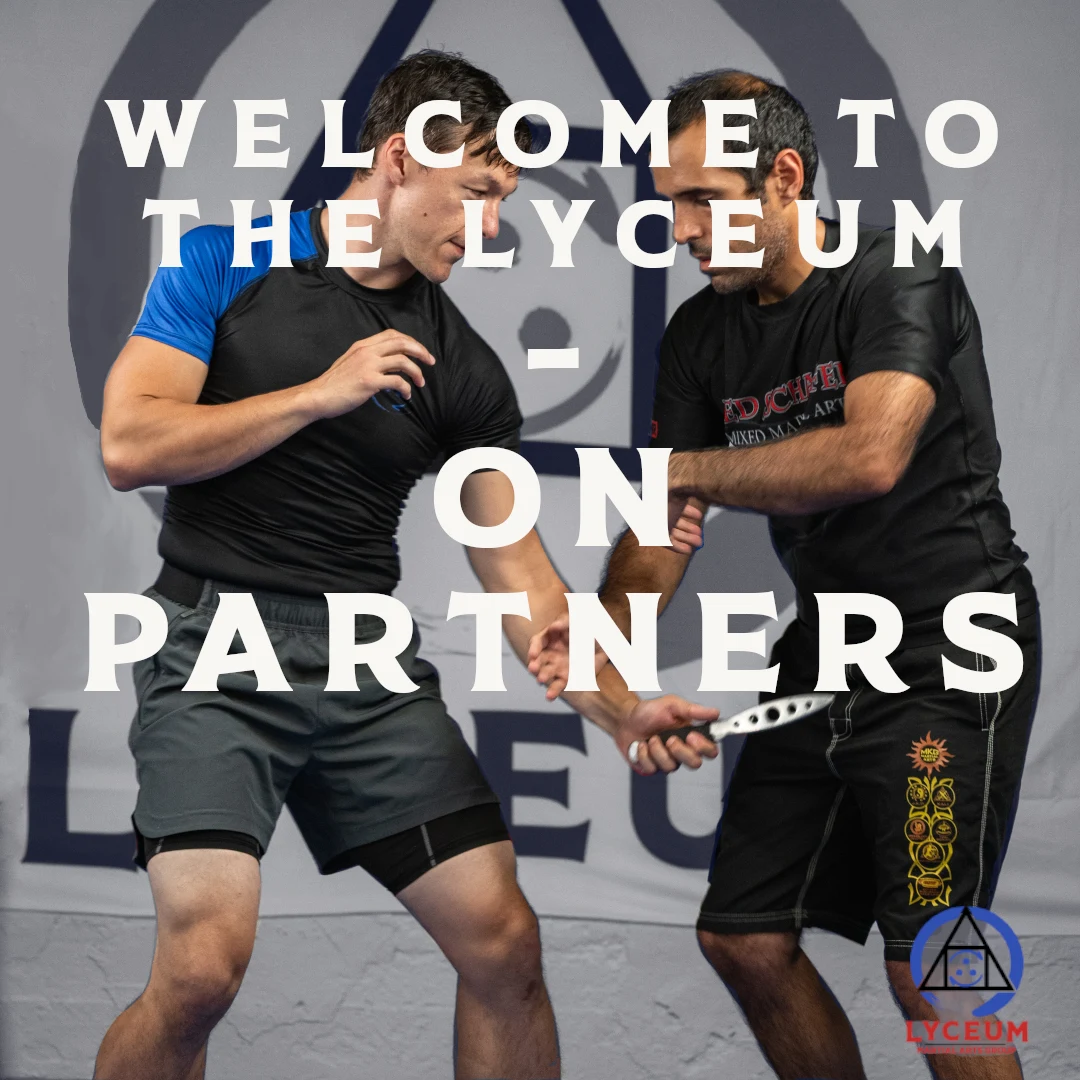
How We Learn Through Each Other - Why Partnering Matters
Movement is relational. Nothing we study can be learned in isolation. Every drill, every exchange, every moment of contact depends on the presence of another person, someone who helps reveal timing, structure, pressure, and intention. A partner is not simply someone who stands across from us. They are the environment through which learning becomes possible.
Alan Watts once noted, “Supposing I walk, and you want to describe the action of walking: you cannot talk about my walking without also describing the floor, because if you do not describe the floor and the space in which I am moving, all you will be describing is somebody swinging his legs in empty space. So as to describe my walking, you must describe the space in which you find me. You know, you could not see me unless you could also see my background, what stands behind me.”
In training, our partners are that background. They give shape to our movement, reflect our choices, and make our timing visible. Without them, we would be practicing inside empty space. With them, every small action becomes part of a conversation.
Some research suggests this same truth: perception and action arise together in relationship with the environment. In our work, the partner becomes the dynamic environment through which perception sharpens. We learn not only by doing, but by doing with.
The Partner Contract (Unspoken Agreements)
Training depends on a set of unspoken agreements, and while they are rarely stated outright, they form the ground of every safe and honest exchange. A partner agrees to care for safety without being fragile. They agree to offer clarity without stiffness. They agree to bring honesty to the round without malice. They meet us with attention, not aggression. They understand that the goal is not to overpower but to explore.
This contract asks for presence. It asks each of us to notice what we are bringing into the interaction. When we tense, our partner feels it. When we rush, they respond to the acceleration. When we soften, they soften. Nothing we do is contained within our own body. Training becomes a shared act of adjusting to one another, responding without ego, and supporting the clarity of the drill.
A partner offers the right level of resistance for the work at hand. Not too much, not too little. They give energy that helps us learn rather than energy designed to dominate. They keep the room honest by staying honest themselves. And in doing so, they help create a culture where learning feels open, safe, and collective.
Giving and Receiving Feedback
Feedback between partners is both verbal and nonverbal. Much of what we communicate in training happens through breath, posture, timing, and attention. Changes in pace, hesitation, or pressure can reveal far more than words. Communication theorists like Paul Watzlawick reminded us that one cannot not communicate. Even silence transmits information. In training, every gesture carries meaning.
A partner senses when their feedback needs to be quiet and when a simple verbal cue may help clarify something that feels confusing. They know that feedback works best when offered with care and without agenda. A gentle suggestion lands well. A critique cloaked as instruction often does not. Words should support learning rather than interrupt it.
Receiving feedback is its own practice. It asks us to hear without defensiveness, to consider without assuming we are being corrected, and to observe whether the suggestion reveals something we had overlooked. When feedback is exchanged openly, it becomes another form of partnering. When it is withheld out of discomfort or delivered harshly, it becomes a barrier.
Feedback is most effective when treated as conversation rather than evaluation. It keeps curiosity alive.
Recognizing Engagement and Overwhelm
One of the most important skills in training together is being able to sense the difference between productive challenge and overwhelm. Engagement has a particular look to it. Breath remains steady. Eyes stay focused. Movements may be uncertain but not frantic. There is a quality of leaning forward into the difficulty.
Overwhelm looks different. Breath shortens. Movements stiffen or collapse. Focus scatters. The body begins to brace rather than explore. When we notice this shift in a partner, we adjust the drill, the pace, or the level of resistance. We offer calmness rather than more pressure. We help them return to the place where learning is possible.
Shared regulation is not a formal method. It is something that happens quietly between partners. Our nervous systems mirror each other. When one person calms, the other often follows. When one person escalates, the other tends to rise with them. This is why ego has no place in training. Ego escalates intensity. Attention softens it.
The partner contract includes a responsibility to notice these shifts early and to respond with care.
Working With Partners of All Experience Levels
Every partner, regardless of experience, teaches something different. Working with beginners helps us clarify fundamentals. Their unpredictability reveals openings and gaps we may have forgotten to examine. Their questions remind us of the concepts that hold the art together.
Working with peers offers a different kind of learning. Timing sharpens. Pressure becomes more honest. Decisions grow faster but stay grounded in shared curiosity. Peers help us understand adaptability and flow.
Working with experienced partners reveals nuance. Their precision helps us refine subtle aspects of structure, rhythm, and strategic intention. They can show us what a concept looks like when embodied more deeply. They can also receive our mistakes without being thrown off balance, which allows for braver exploration.
Experience level does not determine value. It simply changes the lens of the learning. Rank does not define roles because partnering is reciprocal. Each partner reveals something the other cannot see alone.
Honest Energy Without Malice
Training requires honesty. Without it, everything becomes compliant and nothing transfers into real understanding. Yet honesty does not mean aggression. It means giving real problems without domination. It means offering resistance that supports learning rather than shutting it down.
Honest energy lives in the space between collapse and escalation. It asks us to bring enough clarity and resistance that the concept remains visible, but not so much that the exchange turns competitive. When ego enters, learning narrows. When curiosity leads, learning expands.
Honest energy is steady, not sharp. It is present, not demanding. It helps partners explore pressure, timing, and distance without fear of being punished for mistakes. It asks us to act without malice, to challenge without cruelty, and to remember that training is not a place to prove something but a place to discover something.
This ethic protects everyone in the room.
Shared Ownership of the Round
A round is not something one partner does to another. It is something both partners create. Each person shapes the intensity, the clarity, and the pace. Each person contributes to the quality of the exchange. When this is understood, a round becomes less about performance and more about exploration.
Shared ownership means noticing when the drill drifts off course and gently bringing it back. It means adjusting the energy so the work stays honest but not aggressive. It means remaining attentive to the partner’s experience rather than just our own.
In this way, partnering echoes the core values of leadership. Both rely on noticing, adjusting, and caring for the shared space. Both avoid control and support discovery. Both ask for humility. And both grow stronger over time.
Closing Reflection
Partnering is the practice where learning and leading meet. It is where ideas become embodied, where concepts turn into timing, and where our presence becomes part of the learning of others. Each partner becomes a mirror, a guide, and a companion in exploration. We grow because someone stands with us, offering their attention, their structure, and their willingness to enter the unknown.
As we continue to train, partnering becomes less about exchanging techniques and more about understanding how to meet one another with honesty and care. It becomes a way of refining not only our movement but our capacity to listen, to adjust, and to support the arc of shared practice. It becomes a place where ego softens and curiosity leads.
When partnering works well, the room itself becomes wiser. The learning deepens. The exploration broadens. And every person, regardless of experience, contributes to the shape of what unfolds.
Partnering is not something we perfect. It is something we practice. It grows through attention, generosity, and the willingness to remain engaged even when the path is uncertain. It continues to evolve as long as we do.
And when it works, the learning belongs to both people, and to the room that held them.